
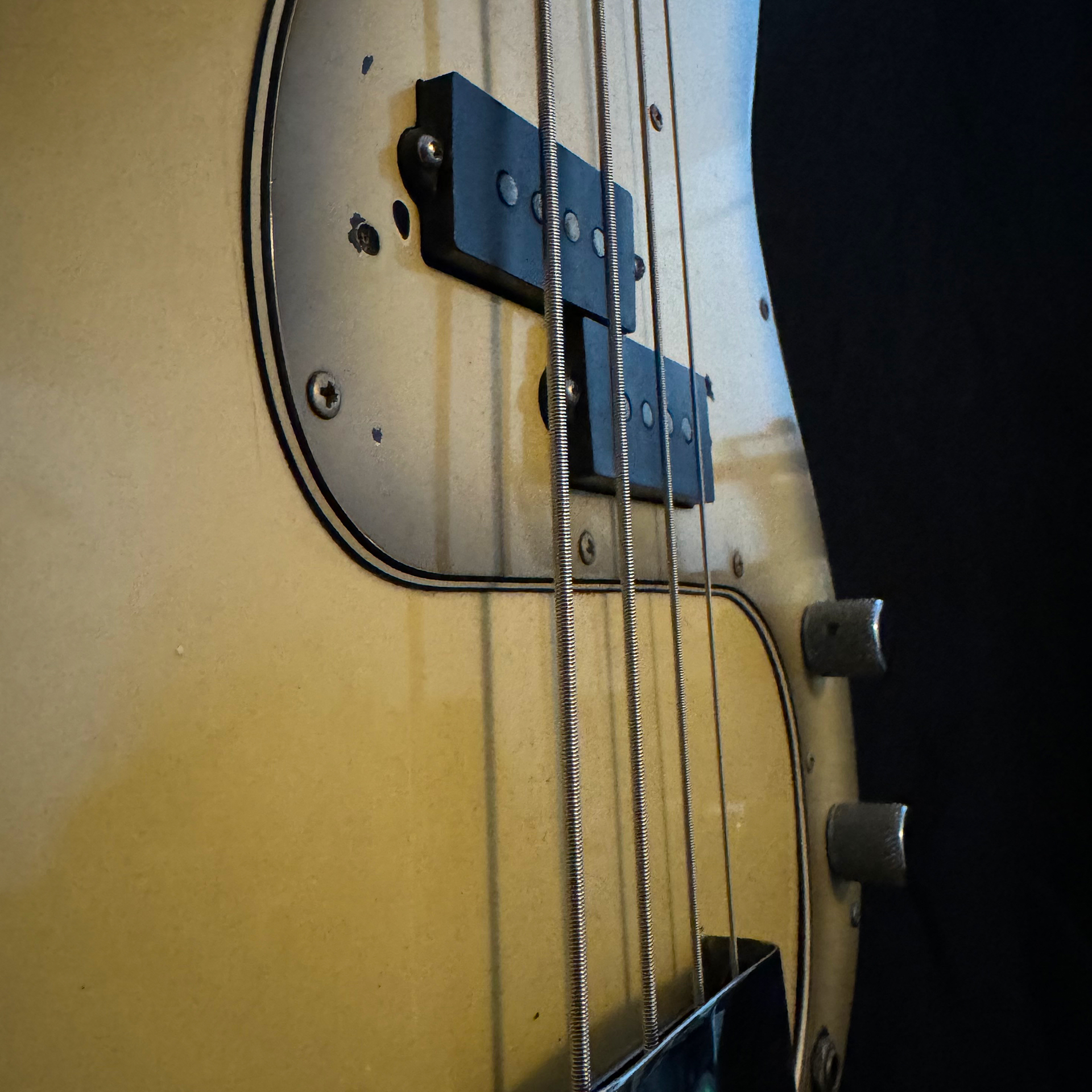
The Fender Antigua Bass: Camouflage that became a cult classic
In the world of vintage guitars, there is no finish more divisive, more debated, or more distinctive than Antigua. To some, it’s a sophisticated, smoky gradient that captures the soul of the 1970s. To others, it’s “the color of a 1975 kitchen appliance”.
But behind the polarizing Avocado burst lies one of the most interesting happy accidents in Fender’s history. In my collection I have three points on that timeline: a 1978 USA Fullerton Precision, and both halves of the 2012 FSR revival, the Precision and the Jazz.
This page covers the whole Fender Antigua story: where the finish came from and why the 1967 and 1977 versions are not the same colour, every Fender that wore it in the 1977-79 run, the 2012 FSR revival in both Precision and Jazz, and how to tell an original from a refinish. Every photograph on this page is of an instrument I own and play.
The Fender Antigua finish: a masterpiece born from a mistake
The story of Antigua doesn’t start with a designer’s vision; it starts with a manufacturing problem. In the late 1960s, Fender was struggling with the Coronado – a hollow-body guitar intended to compete with the likes of Gibson and Gretsch.
The myth (largely confirmed by Fender historians) is that the binding process on the Coronado bodies was burning the edges of the wood. Rather than scrap the inventory, Fender legend Martin De Casas developed a unique burst finish to hide those burn marks. The result was a grey-to-cream gradient that we now know as Antigua. It was, quite literally, manufacturing camouflage.
Here is the part most listings get wrong: the 1967 Antigua and the 1977 Antigua are not the same finish. The Coronado version was a cool, silvery grey-to-cream burst, mixed to disguise scorched wood. When Fender brought the name back ten years later, it came back greener – the warm, olive-tinted burst that people either love or call “pigeon burst”. So when a seller describes a 1978 Precision as “the original Antigua”, they are describing the revival, not the original. The one that started it was a hollow-body guitar, and it looked different.
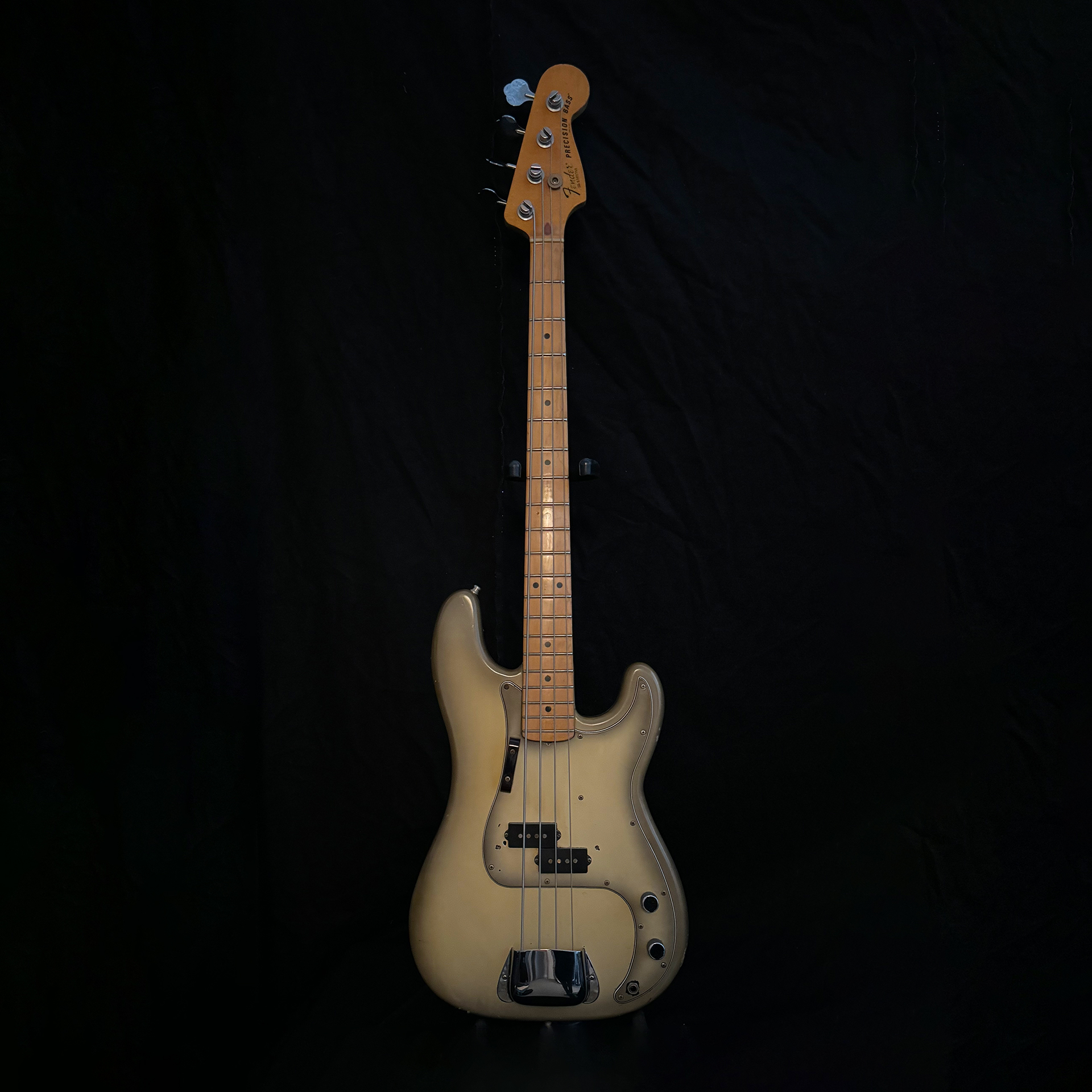
The 1978 Antigua Precision Bass (USA)
The vibe Unlike modern reissues, the ’78 has a smoky character. Decades of light and environment have given it a slightly yellowed, organic patina that makes the gradient feel integrated into the wood.
The design This was the era where Fender went “all in,” painting the pickguard to match the body. It creates a seamless, monolithic look that defines the late-CBS era.
The sound Built in the Fullerton plant, it’s heavy, resonant, and carries that unmistakable 70s thump that has graced thousands of records.
If the 1978 model is the history, the 2012 FSR (Fender Special Run) is the redemption. For decades, Antigua was the “ugly duckling” that players would often strip and refinish. But by the 2010s, it had achieved a massive cult following.
The 2012 FSR Antigua Precision Bass (Mexico)
The scarcity Announced at the 2012 Summer NAMM, Fender only produced 300 of these Precision Basses worldwide. Finding one today is often harder than finding an original from the 70s.
The build Coming out of the Ensenada plant, this bass represents the high-water mark of modern craftsmanship. It’s punchy, reliable, and perfectly captures the “Antigua Green” hue – a slightly more vibrant take on the original recipe.
The status It proves that what was once a “mistake” to hide burnt wood is now a premium rarity that collectors hunt for.
The Precision had a Jazz Bass sibling. Fender announced both at Summer NAMM 2012 – Same alder body, same maple neck and maple fingerboard, same chrome vintage-style bridge.


The 2012 FSR Antigua Jazz Bass (Mexico)
Fender announced both basses in the same week at Summer NAMM 2012, and the Jazz is the one nobody counts. No run size was ever published for it. A figure of 250 circulates in used listings, but it traces back to seller descriptions rather than to Fender, so it belongs with the folklore rather than with the 300 Precisions.
It is also not a Precision with Jazz pickups. The Jazz got a 7.25″ (184.1 mm) fingerboard radius, the pre-1983 vintage curve, on a Mexican production bass built in 2012. Medium jumbo frets, a 1.5″ (38.1 mm) nut, and a neck that has more in common with a seventies Jazz than with anything else leaving Ensenada that year.
There is a historical argument for the Jazz too. When Antigua came back in 1977 in the greener, graduated version people picture today, the Jazz Bass carried it, body and pickguard both. So the model usually told as a Precision story is arguably the reissue of the bass that opened the second Antigua era.
1978 original vs 2012 FSR, side by side
| 1978 Precision | 2012 FSR Precision | 2012 FSR Jazz | |
|---|---|---|---|
| Built | Fullerton, USA | Ensenada, Mexico | Ensenada, Mexico |
| Body | Alder | Alder | Alder |
| Neck / fingerboard | Maple | Maple | Maple |
| Bridge | Vintage 4-saddle | Chrome standard vintage 4-saddle | Chrome standard vintage 4-saddle |
| Nut | Moulded plastic | Synthetic bone | Synthetic bone |
| Production | Catalogue model, 1977-79 | Special Edition, 300 units(?) | Special Edition, 300 units(?) |
| Finish character | Ambered centre, softer green | Cleaner, more vivid “Antigua Green” | Cleaner, more vivid “Antigua Green” |
The Fenders that wore Antigua, 1977-79
The 1977 reintroduction was purely cosmetic – no burnt wood to hide this time, just a custom colour Fender thought would sell. It ran until 1979 and it was not a boutique option: Antigua was offered across most of the line.
| Model | Antigua years | Notes |
|---|---|---|
| Precision Bass | 1977-79 | Shaded white-to-brown burst, matching painted pickguard |
| Jazz Bass | 1977-79 | Same treatment; bound maple board with block inlays typical |
| Mustang Bass | 1977-79 | The short-scale option to carry the finish |
| Stratocaster | 1977-79 | 3-bolt neck, 5-way switch from 1977 |
| Telecaster | 1977-79 | Retained the 4-bolt neck plate |
| Telecaster Custom / Deluxe | 1977-79 | The humbucker-equipped variants |
| Mustang | 1977-79 | The student-line guitar |
Worth saying plainly, because the vintage market likes to imply otherwise: these were catalogue instruments, not limited runs. Antigua Fenders are uncommon today because the finish was unpopular and thousands were stripped and refinished through the eighties and nineties – not because Fender built very few. An unmolested one is genuinely scarce. An Antigua that merely exists is not.
How to tell a real Antigua from a refinish
Antigua is one of the easiest finishes to fake badly and one of the harder ones to fake well. Here is what I check, working from my own 1978 – the tells are physical, and photographs from a seller rarely show them unless you ask.
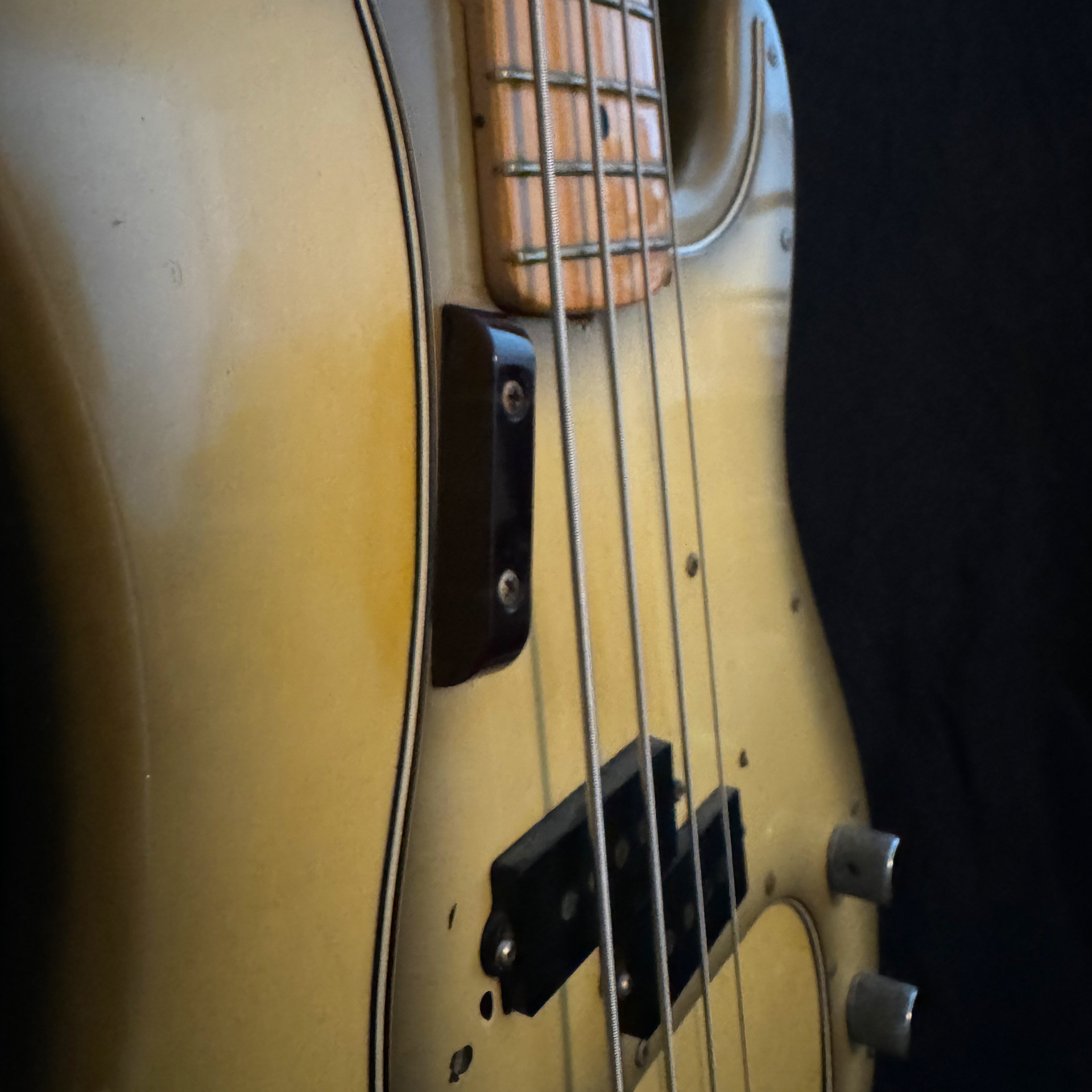
The pickguard. This is the first thing to check and the hardest to fake. Fender did not use a coloured plastic guard – they took a black plastic guard and painted it in Antigua to match the body. On an original the guard’s finish has aged at a different rate to the body, because it is a different substrate underneath. A guard that matches the body too perfectly is a warning sign, and a plain black or white guard means the original is gone.
The burst pattern. Antigua was sprayed at the factory as a soft, even band following the body outline, and that consistency is hard to reproduce. Look at the width of the coloured band at four points: the upper horn, the waist, the lower bout and the heel. On a factory finish those bands are close to uniform and the transition into the cream centre is gradual, with no hard edge anywhere. Refinishers almost always give themselves away in the cutaways, where the original band stays tight and an amateur spray goes wide or blotchy. Check that the colour also wraps the sides of the body continuously rather than stopping at the top edge.
Under the neck plate. Fender finished bodies complete before the neck went on, so on an original the Antigua runs unbroken beneath the neck plate and into the heel area. Undo the plate and you should find the same finish, in the same condition, as the surrounding body. Two things suggest a refinish: a hard masked edge where someone worked around the plate rather than under it, and a build-up of fresh finish in or around the neck pocket that sits proud of the original surface. Original pockets carry light overspray rather than a full glossy coat. While the plate is off, check the finish thickness at the screw holes. A refin laid over the top of the original will read noticeably deeper there.
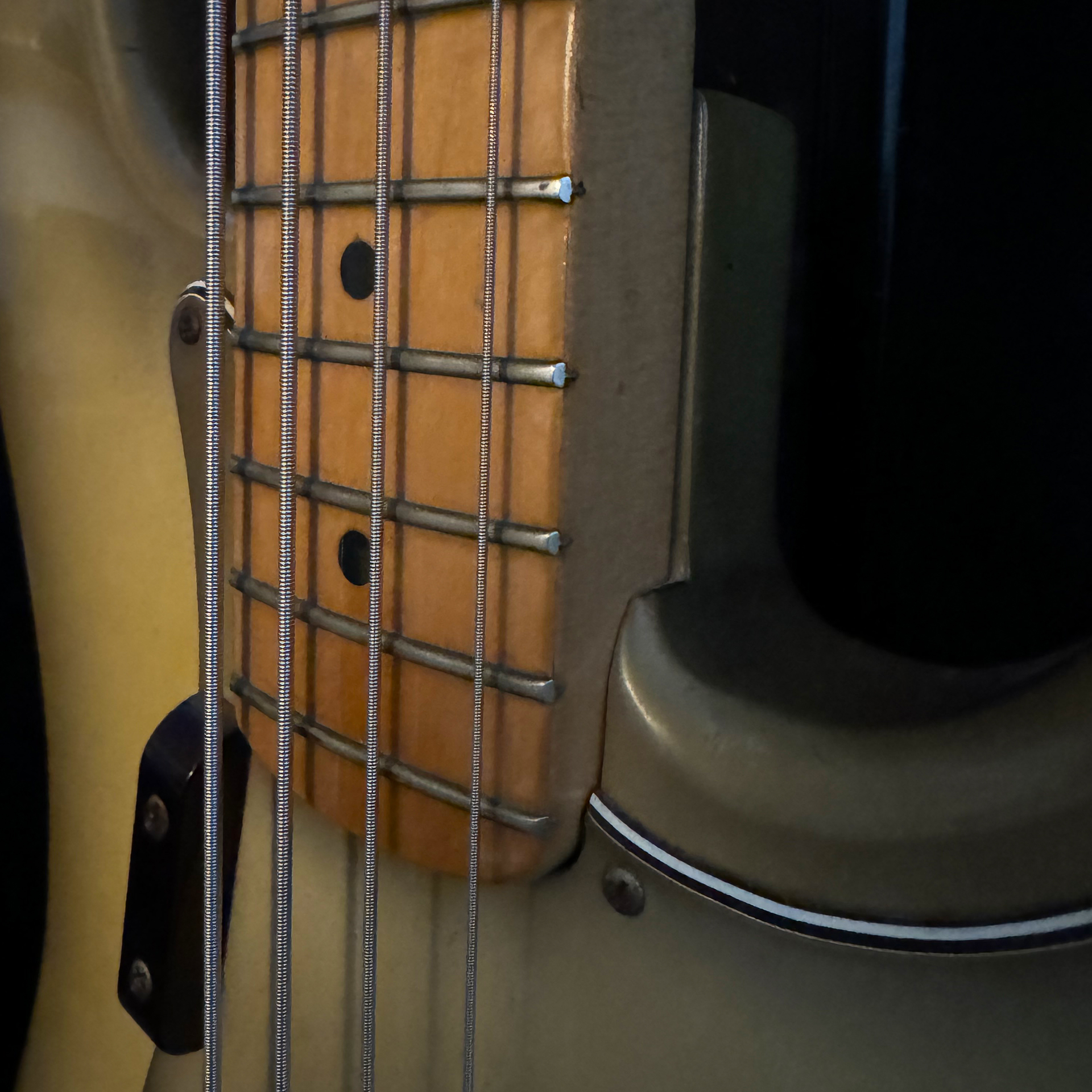
The logo and the hardware. Late-CBS instruments carry the large black Fender logo, thick polyester finish, black knobs and black pickup covers. None of that proves the finish is original, but anything inconsistent with a 1977-79 build spec on a claimed Antigua of that period is worth a second look before you go further.
Fender Antigua Bass FAQ
What is the Fender Antigua finish?
A shaded burst that runs from a cream or off-white centre to a green-brown edge, with a matching painted pickguard. Fender first used it around 1967 on the Coronado to hide scorch marks left by the binding process, then brought it back as a straight custom colour from 1977 to 1979. The two versions do not look the same – the sixties original was greyer, the seventies revival distinctly greener.
Which years did Fender make Antigua basses?
Two windows. The original run was 1977 to 1979, covering the Precision Bass, Jazz Bass and Mustang Bass. Fender then revived it as a Factory Special Run in 2012, announced at Summer NAMM, in both Precision and Jazz, built in Ensenada and sold through 2013. Fender built 300 of the FSR Precisions; no figure was published for the Jazz.
Was there an Antigua Jazz Bass?
Yes, in both eras. The Jazz Bass was part of the 1977-79 catalogue run, and it returned alongside the Precision in the 2012 FSR. I own the 2012 FSR Jazz as well as both Precisions, so the 1978 photographs here are P-Basses and the FSR photographs cover both.
What is the difference between the 2012 FSR Antigua Precision and Jazz?
More than the pickups. The Jazz has a 7.25″ fingerboard radius, medium jumbo frets and a 1.5″ nut; the Precision has a 9.5″ radius, vintage-style frets and a 1.625″ nut. Body wood, neck wood, bridge and nut material are the same, but the necks are not the same instrument. Fender published a run size of 300 for the Precision and never published one for the Jazz.
Why is Antigua so divisive?
Because it does not look like anything else Fender made, and because for thirty years it was the finish nobody wanted. Plenty of originals were stripped and refinished in the eighties and nineties by owners who thought they were doing the instrument a favour. The taste has flipped since – the ones that survived untouched are now the ones collectors chase.
How do I tell an original Antigua from a refinish?
Start at the pickguard. Fender painted a black plastic guard to match the body, so on a genuine one the guard has aged at a different rate to the body – different material, different response to light. A guard that matches too perfectly, or a plain black or white guard, means the original finish is gone or the guard has been replaced.
Are Antigua basses rare?
Less rare than sellers imply, and rarer than that in good condition. Antigua was a catalogue option across most of the Fender line in 1977-79, not a limited run. What is genuinely scarce is an unmolested one with its original matching pickguard intact. The 2012 FSR is the opposite case – a genuine limited run of 300 Precisions worldwide, and now harder to find than a seventies original.
Owning these two side-by-side is a reminder of why I love playing different basses. It’s not just about the wood and wires! We have one bass that was a clever solution to a factory error, and another that was released many years later because that “error” became an icon.
Whether you love the look or still think it looks like a mid-century refrigerator, you can’t deny that Antigua has a soul.
Henrik Bonde Hanfgarn owns an original 1978 Antigua Precision and both sisters of the 2012 FSR revival, the Precision and the Jazz Bass. Every photograph here is of an instrument in his own vault. More about Henrik.
The three Antiguas in the vault
- 1978 Fender Precision Bass, Antigua (USA) – the Fullerton original, matching pickguard intact
- Fender FSR Antigua Precision Bass, Antigua Green – one of 300(?), Ensenada 2012
- Fender FSR Antigua Jazz Bass, Antigua Green – one of 300(?), Ensenada 2012
- Rare Fender bass colours – Antigua alongside Shell Pink, Surf Green and Classic Copper