
Signature Bass Guitars: Eleven in the vault and what the name really buys
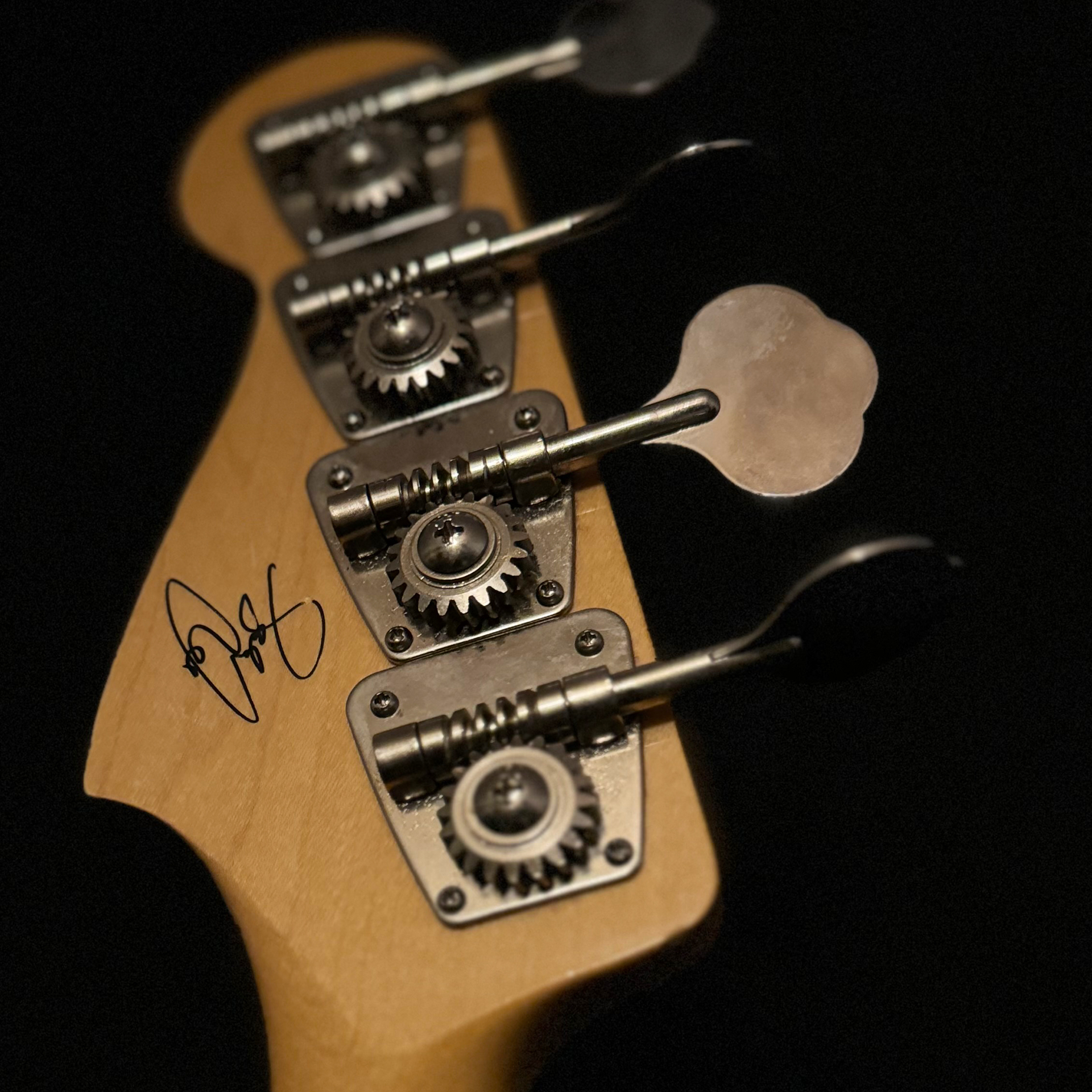
Signature bass guitars get dismissed as marketing. A famous name on the headstock, a higher price, and the same instrument underneath. I have eleven of them in the Bass Vault and I have played all of them, so let me be more precise than that.
Some signature basses are the cheapest route to a specification Fender will not sell you any other way. Some are a finish and a decal on a standard production instrument. Both are fine purchases. The problem is that the marketing copy makes them sound identical, and the price often does too.
Here is how my 11 break down.
Three kinds of signature bass
The spec you cannot otherwise buy The artist wanted something unusual, Fender built it, and because the artist is the reason it exists, the signature model is the only place it lives. The Sting and the Duff McKagan are the clearest cases in my collection.
The shortcut The specification exists elsewhere in the catalogue, but the signature model bundles it at a price or in a country of origin that makes it the sensible buy. The Geddy Lee is this.
The single instrument Not a model, one bass. Fender copied a specific instrument belonging to a specific player, down to the wear on it. The Flea and the Nate Mendel are both this, and it produces some of the most idiosyncratic specifications in the catalogue.
Very few signature basses are pure cynicism. Most are somewhere on this scale, and the useful question is not “is it worth it” but “which of the three am I looking at”.
The Sting: a Japanese domestic reissue with a name on it
My 2006 Sting Signature Precision Bass is the best argument for signature models I own, and most people miss why.
Strip the signature block inlay off the twelfth fret and what you have is essentially Fender Japan’s ’54 Precision reissue: a single-coil pickup in the early style, maple neck and maple board, two-tone sunburst, two-saddle bridge. That reissue was a Japanese domestic model. If you lived anywhere else, the Sting was how you bought one.
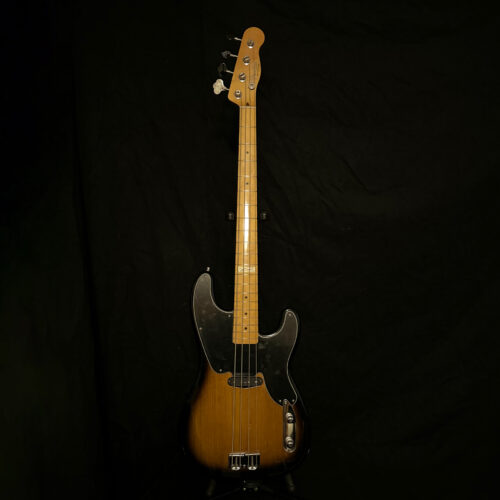

That is the whole point. The name on the fingerboard was not the product. The name was the export licence.
It plays like nothing else in the vault. One pickup and a neck that is narrower at the nut than a ’57 or ’62 P but noticeably deeper front to back. Notes come out open and slightly raw, with a bark that a split-coil rounds off. It is not versatile and it is not supposed to be.
The Duff McKagan and the bass it reissues
This is the pairing I am most pleased with, because I own both ends of it.
The Fender Jazz Bass Special was a Made in Japan model from the mid eighties: a Precision body, a Jazz neck, P and J pickups together, TBX tone circuit, black hardware. It was not a signature model. It was a production oddity, and it was discontinued.


Duff McKagan recorded Appetite for Destruction on one. Years later Fender reissued it as his signature model, in Pearl White with a skull neck plate, and that reissue is the only way to buy the configuration new.
I have the 1993 Jazz Bass Special in Gun Metal Blue as well, so the two sit next to each other on the wall. Playing them back to back is the clearest demonstration I can give of what a signature model actually is. The 2015 is the better-finished instrument. The concept is identical, and one of them costs more because of a name attached to a record that came out in 1987.
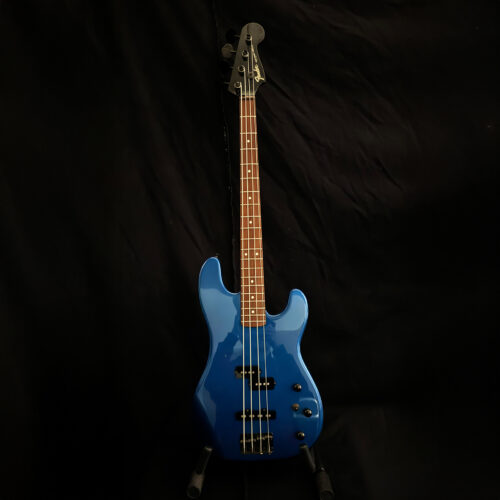

If you want this specification and you do not care about the Pearl White, hunt the original MIJ Jazz Bass Special instead. It is the same idea for less money, and it is genuinely Japanese. My field guide to Fender Japan covers how to date one.
The Geddy Lee: the shortcut
The 1998 Geddy Lee Limited Edition is a black Jazz Bass with a maple board, black block inlays and binding, built in Japan. The specification is not exotic. What it is, is a coherent seventies-style Jazz assembled properly and sold at a price the American equivalent never came close to.
There is a reason this is one of the most consistently recommended signature basses ever made, and it is not Rush. It is that the neck is unusually slim and the whole instrument was specified by somebody who plays for a living rather than by a product committee.
This is the shortcut category at its best. You are not paying for access to a rare spec. You are being handed a good set of decisions.
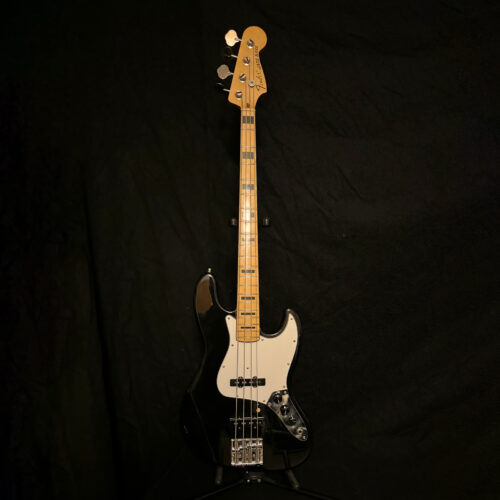

This one has been out of the house more than most. I took it to Rus og Riller and shot it among the racks, which is its own story.
The Hama Okamoto basses: a spec hiding in plain sight
I have three of the Hama Okamoto Precision Bass #4 – two in three-colour sunburst and one in Olympic White – which probably says something about me.
The idea is simple and it should not be a signature model at all: a Precision body with a Jazz-width neck. Players have been building this combination out of parts for fifty years. Fender sells it as a Japanese-market artist model because Hama Okamoto asked for it.
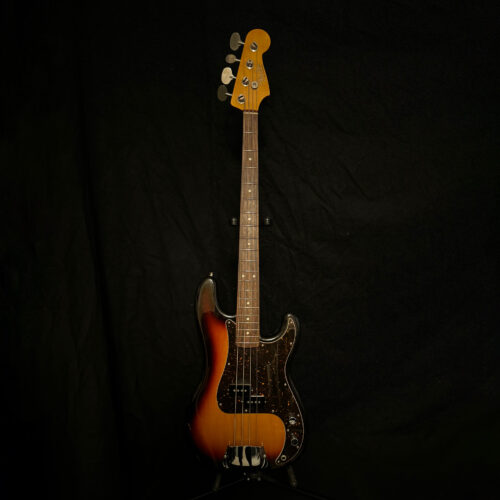
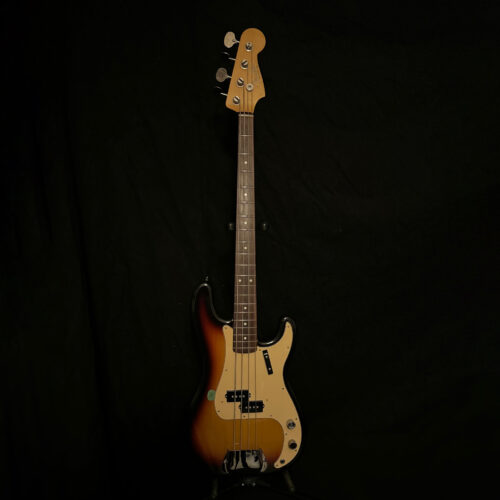
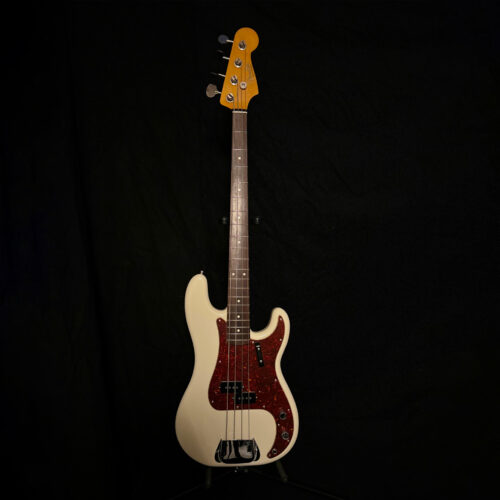
If you find the standard P neck too wide and the Jazz body too thin-sounding, this is the instrument, and the only reliable way to buy one new is under somebody else’s name. That is the spec-access category again, in a much quieter way than the Sting.
Two basses copied from one bass each
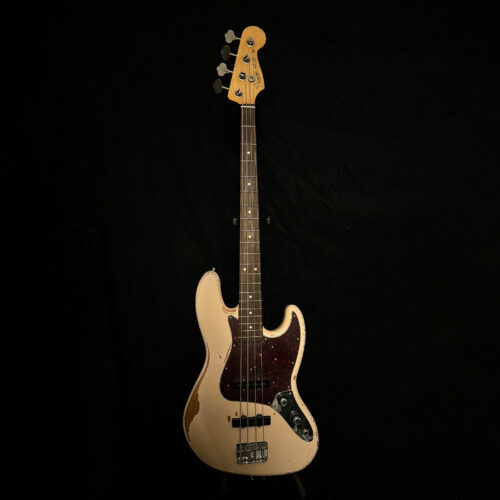
The 2016 Flea Jazz Bass in Shell Pink and the 2013 Nate Mendel Precision in Candy Apple Red are the two in the vault most often written off as expensive paint jobs. Both are Mexican-built, both are loud colours, and both carry a famous name. It is an easy assumption to make and it is wrong on the specification sheet.
The Flea is a copy of one particular 1961 Jazz Bass, given to him by a fan and played on Stadium Arcadium and The Getaway. That means stacked concentric controls, volume and tone for each pickup on a single shaft, which is a 1960 to 1962 feature and appears on nothing else Fender currently builds. Add Pure Vintage ’64 pickups, a U-shaped neck, a 7.25″ radius and threaded steel barrel saddles, and what you have is a stack-knob Jazz Bass sold at a fraction of what a real one costs. I have spent a fair amount of time hunting stack-knob Jazz Basses. This one arrived without the hunt.
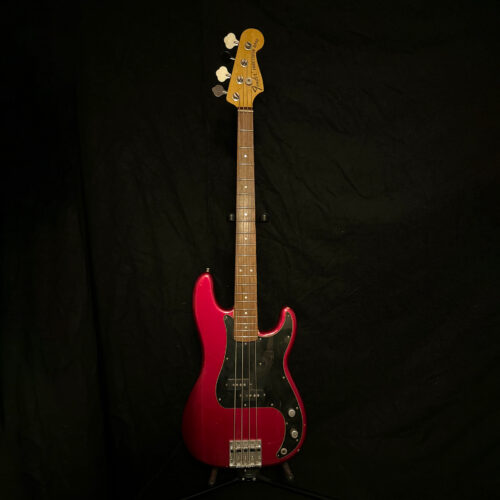
The Nate Mendel is the same idea aimed at a 1971 Precision, the one instrument he has played through Sunny Day Real Estate and the Foo Fighters. The nut measures 1.615″, which is narrower than any standard P and most of a Jazz, on a slim C profile copied from his neck. The body is ash with contours specific to his bass, finished in nitrocellulose and lightly worn. The pickup is a Seymour Duncan Quarter Pound rather than anything from the Fender parts bin.
Neither of these is a restyled production bass. They are forensic copies of two instruments that happen to be idiosyncratic, and the idiosyncrasies are the product.
What that costs you is flexibility. A stack-knob circuit is a genuine commitment, not a period detail you stop noticing, and the Quarter Pound in the Mendel is a hotter and more aggressive pickup than a vintage split-coil. You are buying somebody else’s settled preferences, arrived at over decades of playing. If those preferences match yours, these are among the best value instruments Fender makes. If they do not, no amount of provenance will fix it.
That is the honest caution on this category. Not that you are paying for a name, but that you are paying for a very specific set of answers to questions you may not have asked yet.
Outside Fender
Two of the eleven are not Fenders and they extend the pattern.
The Epiphone Jack Casady in Metallic Gold is a semi-hollow with a low-impedance pickup and a three-position output control. Nothing else on the market does what it does, at any price. It is the purest example of the first category in the whole vault: without Casady, this instrument would not exist. It is also the one I took out into a Danish rapeseed field in May, gold on gold, which turned out to be the only sensible thing to do with it.


The Lakland Skyline Darryl Jones in Lake Placid Blue is a Jazz-style bass built to Jones’s specification, made in Indonesia to keep it affordable. It sits between the shortcut and the spec categories, and it is one of the best-value instruments I have handled.
What I would actually tell you to buy
Work out which of the three categories you are looking at before you look at the price. If it is spec access, the signature model is usually the rational purchase and often the only one. The Sting, the Casady and the Hama Okamoto are worth what they cost because there is no substitute.
If it is a shortcut, check the alternative first. The Geddy Lee still wins that comparison. Some others do not.
If it is a single-instrument copy, play it before you commit. The specification is real and often unavailable elsewhere, but it was chosen by somebody else for their hands and their band.
And in almost every case, ask what the signature model is a reissue of. Sometimes, as with the Duff McKagan and the Jazz Bass Special, the original is still out there, still excellent, and considerably cheaper.
The full set is in the signature and artist bass collection, each one dated, specified and photographed.
Frequently asked questions about signature bass guitars
Are signature bass guitars worth the extra money?
It depends what the signature model gives you. When it is the only way to buy a particular specification, such as the single-coil Sting Precision or the Precision body with a Jazz neck on the Hama Okamoto, the premium buys something real. When the instrument underneath is a standard production bass in a different colour, you are paying for the finish and the association, which is a legitimate reason to buy but not a specification argument.
What is the difference between an artist series and a signature bass?
In practice, very little. Fender uses Artist Series as the umbrella name for its signature instruments, so an artist series Precision Bass and a signature Precision Bass are the same category. The meaningful distinction is not in the naming, it is whether the model reissues a genuinely unusual specification or restyles a current production bass.
Which signature bass is the best starting point?
The Geddy Lee Jazz Bass, if you can find one. It is a seventies-style Jazz with a slim neck and sensible appointments, it was built in Japan, and it has been consistently well regarded for decades without relying on the artist connection to justify itself. It tells you whether you like the format before you spend money chasing a rarer specification.
It’s all about the passion!
Henrik Bonde Hanfgarn aka. BassGarn has played bass for thirty years and documents the forty-odd instruments in the Bass Vault – photographs, specs and stories, with particular depth in Fender Japan MIJ and CIJ reissues.
He plays live in Denmark with Bad Boys of Boogie and Foo Fighters Tribute. The bass hook on Nü Néon’s “Vi Kysser Natten Farvel” came out of a short-scale Mustang from the vault. He talked about the collection with Danske Bassister.
Main Gear TC Electronic Blacksmith, Fender Bassman ’67 (AB165), Ampeg cabs, and the Line6 HX Stomp when it calls for quick and compact.
Instagram · More about Henrik
Explore basses in unexpected locations or The Bass Vault Playlist.

