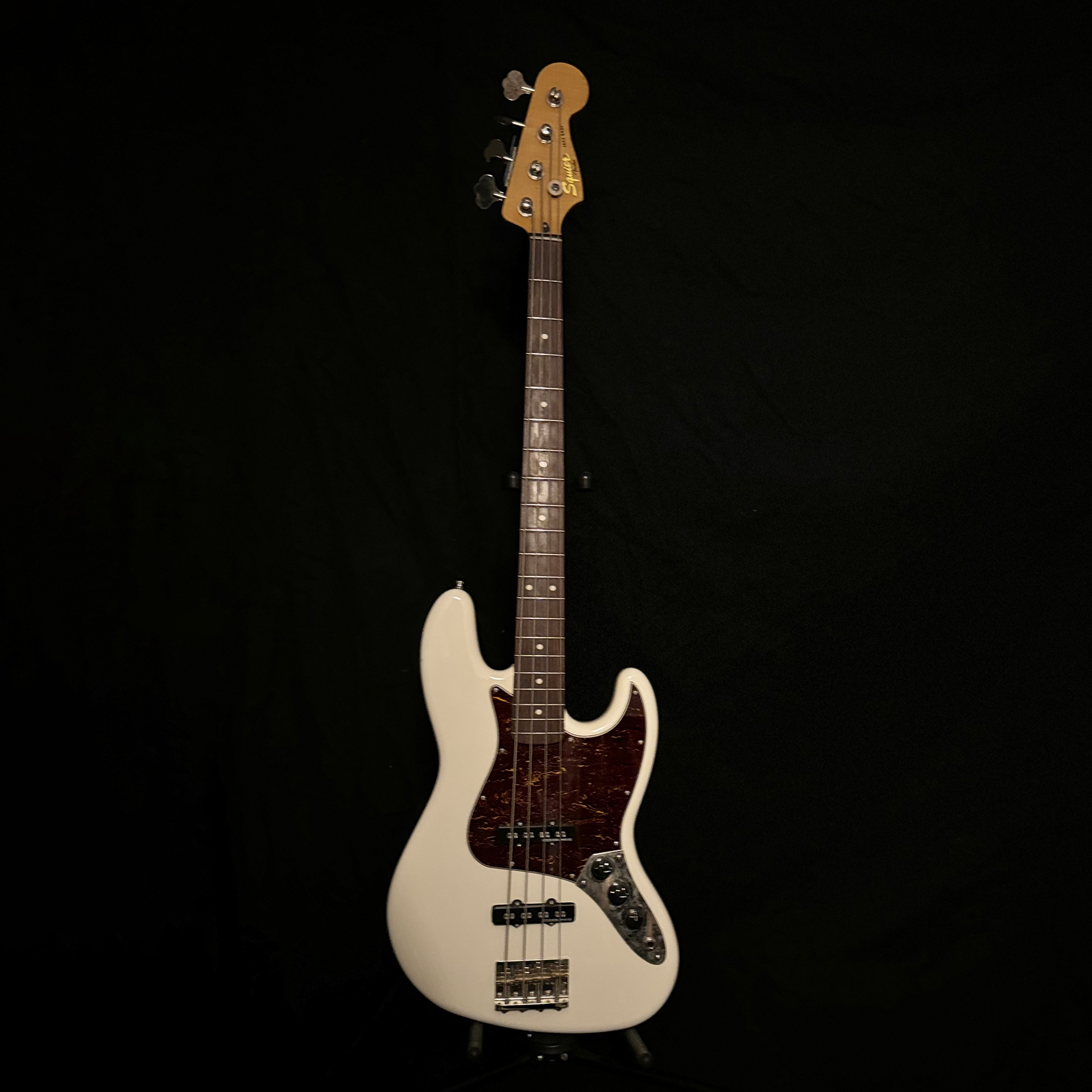
1982 Fender Japan JB62-115 “JV Serial” Jazz Bass, Vintage White
Year: 1982
Finish/Color: Vintage White
Made in: Japan
Factory/Plant: FujiGen Gakki
In March 1982 Fender stopped fighting the best of the Japanese copy makers and went into business with them. Fender Japan was set up with the distributors Kanda Shokai and Yamano Gakki, and the building went to FujiGen Gakki in Matsumoto, the factory that had spent years making Greco copies good enough to worry Fullerton. Part of the deal was that the Greco Fender copies had to stop. That spring the new company launched its first lineup, the Vintage Series: fourteen models in all, six of them basses. At the top of the bass list sat the JB62-115. This is one of them, serial JV11862, with a neck finished on 23 August 1982, in the first summer Fender Japan existed.


115 is a price, not a spec
Fender Japan model codes look like engineering. On the first lineup they were closer to a shop label. JB62 tells you the model and the reissue year. The number after the dash was the retail price in thousands of yen, so the JB62-115 cost ¥115,000. Many still carry a small “115” sticker on the back of the headstock to prove it. This one does, forty-odd years later, between the tuners.
The price bought real differences. The Jazz Bass came in two grades, the JB62-115 and the JB62-75, and only the top one got Fender USA pickups, pickguard and controls, plus a lacquer finish. So a first-year JB62-115 is a Japanese-built bass with an American electrical heart, assembled while the factory supplying those parts was still owned by CBS.
The suffix logic kept evolving for three decades afterwards, which is why a code like PB70-70 or JB62-58 needs decoding. The full key is in the Fender Japan Model Code Decoder.
When Fender launched the ’62 Jazz Bass Reissue in 1982, it needed stacked concentric pots, a part nobody else on earth was ordering in volume, and it bought them in one large batch. That batch then lasted for years. The result is a well-known quirk among people who work on these: eighties stack-knob reissues turn up again and again with 1982 electronics, and it is the expected finding rather than the exception.
The logic is worth internalising, because it applies to every Fender you will ever try to date. A pot code tells you the earliest the instrument can be. It never tells you when it was. A 1989 stack-knob reissue with 1982 pots almost certainly has its original electronics.


Two Vintage Series, one year
This is the coincidence that makes 1982 such a strange year for the Jazz Bass. In California, Fender launched its own Vintage Series that same year: rebuilding the old instruments from the old drawings, with the ’62 Jazz Bass as a founding model. In Japan, the newborn Fender Japan launched a lineup with the same name, the same idea and the same bass.
Both reissues wore stacked concentric knobs, and both answered the same question: what if Fender built the pre-CBS instruments properly again? The American one was built in Fullerton and later Corona. You can see how that answer had settled in by the end of the decade on the 1989 American Vintage ’62 Jazz Bass in Lake Placid Blue in the Vault. The Japanese one was built at FujiGen with parts shipped across the Pacific. This is that one.
Stack knobs on a Japanese ’62
The original Jazz Bass launched in 1960 with stacked concentric controls, a volume and tone pair for each pickup. That layout lasted until Fender switched to three knobs during 1962. So a stack-knob “’62” is really a late-1961 bass in reissue clothing, and the JB62-115 copied exactly that.
It didn’t last. The JB62 most people know settled on the three-knob layout, and Fender Japan built it in huge numbers through the eighties, nineties and noughties. The first-year top model is the outlier in its own family, which is part of why collectors in Japan hunt the JV-serial versions so hard. The full story of the model that followed is on the Fender Japan JB-62 Jazz Bass page.
What JV11862 tells you
JV is the first Fender Japan serial prefix, and Fender’s own table dates it to 1982-1984. It sits on the headstock decal, and on first-year instruments the decal carries a small “Made in Japan” under the Fender logo, as this one does. That was apparently unpopular, and the text moved to the neck heel area later, so it works as a quiet first-era marker.
The serial alone won’t pin the month. Early Fender Japan records are incomplete, and JV numbers weren’t issued in tidy chronological blocks. The proof is on the neck. Take the neck off this bass, and the end of the heel, just under the truss rod adjuster, reads 8-23-82 in pencil: 23 August 1982.
There’s a neighbour that backs it up. Another JB62-115, serial JV10484, carries a neck date of 8-21-82. Same model, same factory, two days apart, with the higher serial carrying the later date. Neither bass needs a database to date it. They date each other. The heel underside carries two more marks: a dark hand-written character and a small red ink circle. Like the inspector marks on American Fenders of the period, nobody has published a key to them. If you own a JV-era Fender Japan with similar marks under the heel, I’d like to see them.
Frequently asked questions about the Fender Japan JB62-115
It’s the original retail price: ¥115,000. On Fender Japan’s first 1982 lineup, the number after the dash in the model code was the price in thousands of yen, and many examples still have a small “115” sticker on the back of the headstock. The JB62-115 was the top Jazz Bass in that lineup, above the JB62-75.
Yes. In the 1982 Vintage Series, the top-grade models, including the JB62-115, were fitted with Fender USA pickups, pickguard and controls and given a lacquer finish. The cheaper JB62-75 didn’t get the full USA parts set, which is one reason the 115 is the more sought-after of the two.
Fender dates JV serials to 1982-1984 but notes that early Fender Japan records are incomplete, so the serial is a guide rather than proof. Take the neck off and look for a hand-written date on the heel end: this JB62-115, serial JV11862, reads 8-23-82. Pot codes then give the earliest possible build date, and a “Made in Japan” line under the headstock logo marks the earliest instruments.
For the wider picture, the Fender Japan bass archive collects every MIJ and CIJ bass in the Vault, Jazz and Precision alike.