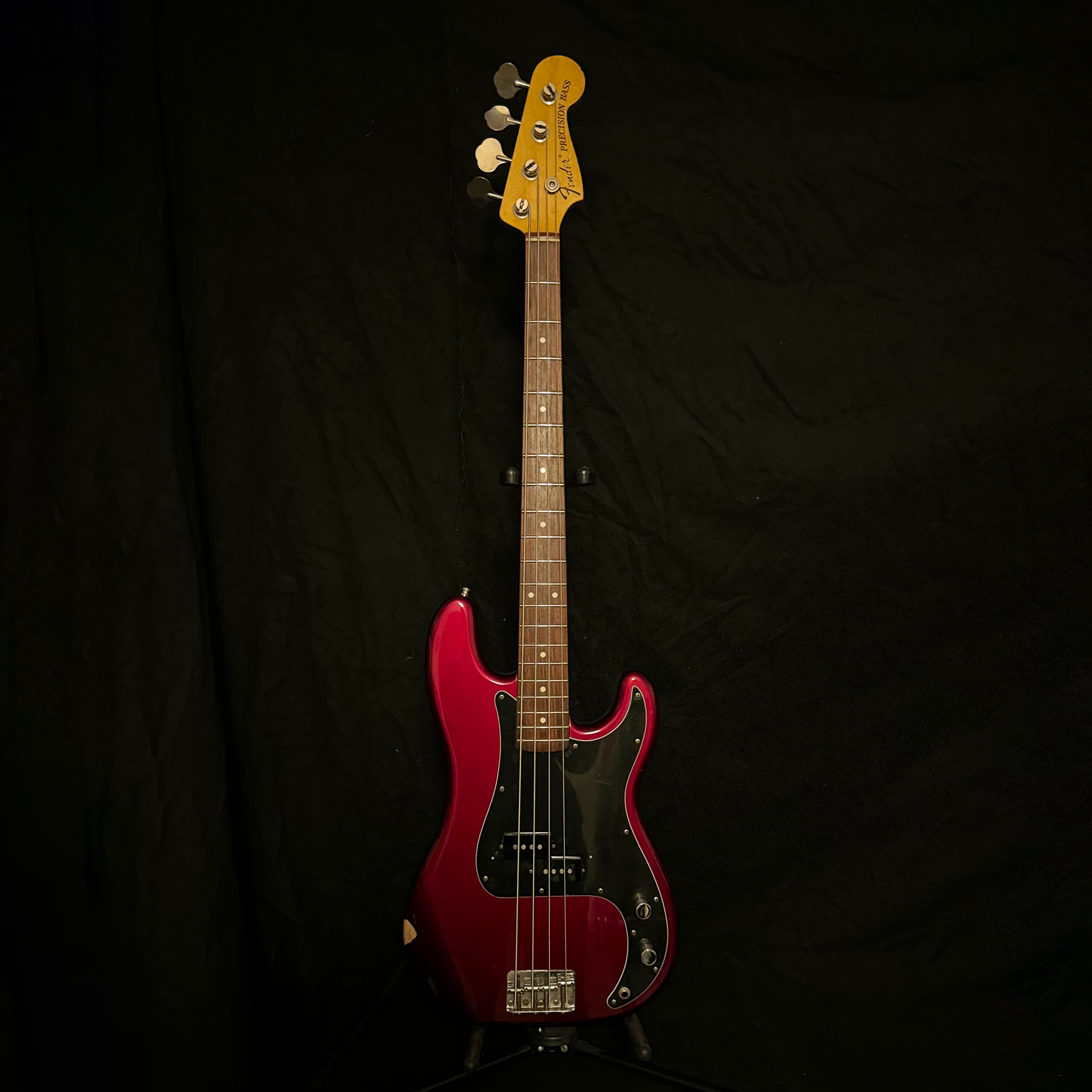
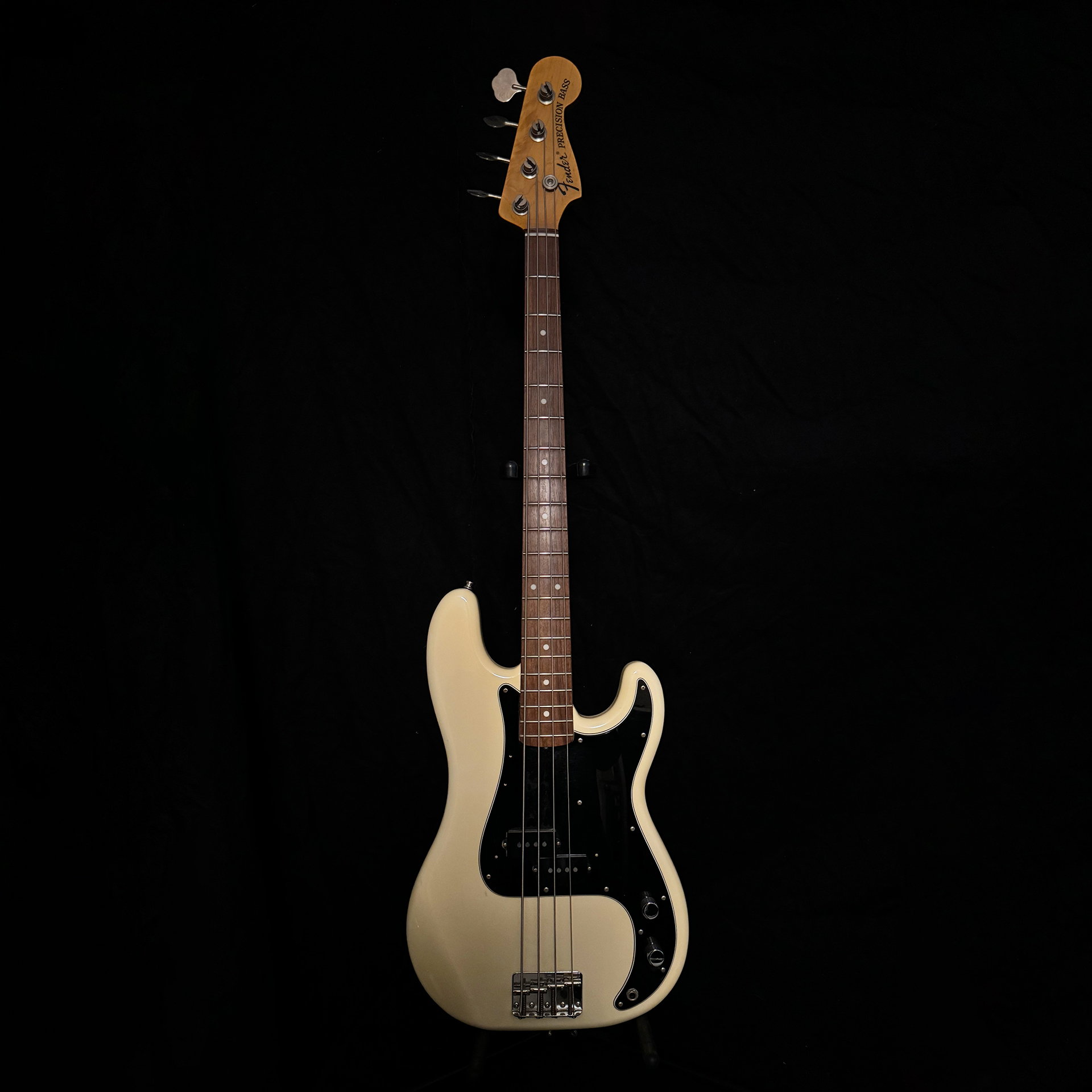
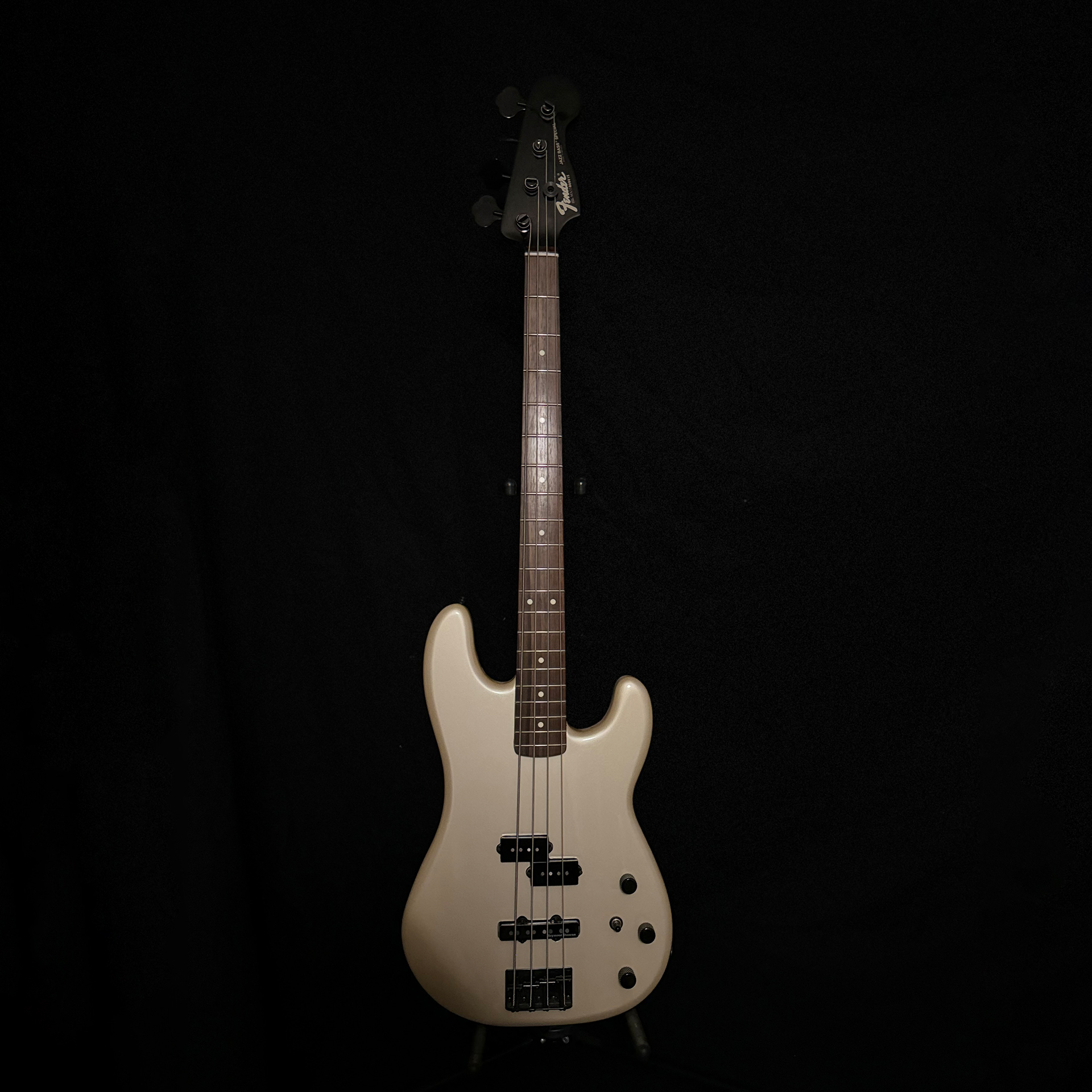
1989 Fender American Vintage ’62 Jazz Bass, Lake Placid Blue (USA)
Year: 1989
Finish/Color: Lake Placid Blue
Made in: USA
Factory/Plant: Corona, California
In 1982 Fender did something close to an admission of guilt. Rather than redesign its way out of the CBS years, it started building the old instruments again, from the old drawings, and called the result the Vintage Series. The ’62 Jazz Bass was one of the founding models. By the time this one was made, Fullerton had closed, the company had been bought out from CBS by its own management, and US production had restarted in a new plant at Corona. So this bass is a reissue of a 1962 design, built in 1989, by a company that had just spent four years reassembling itself. In Lake Placid Blue, a custom colour offered on this model only in a narrow window around the turn of the nineties.


The pots are dated 1982. That is correct.
Open the control cavity and the concentric pots carry 1982 date codes, seven years before the neck was shaped. It looks like a red flag. It is the opposite.
When Fender launched the ’62 Jazz Bass Reissue in 1982, it needed stacked concentric pots, a part nobody else on earth was ordering in volume, and it bought them in one large batch. That batch then lasted for years. The result is a well-known quirk among people who work on these: eighties stack-knob reissues turn up again and again with 1982 electronics, and it is the expected finding rather than the exception.
The logic is worth internalising, because it applies to every Fender you will ever try to date. A pot code tells you the earliest the instrument can be. It never tells you when it was. A 1989 stack-knob reissue with 1982 pots almost certainly has its original electronics.


Dating a Vintage Series bass from its own stamps
This one dates itself, twice, in pencil-and-ink terms: The neck heel reads APR 24 1989, stamped on the shaping and finishing line. The neck pocket reads MAY 1 1989, alongside BUFF OP-30, understood among collectors as the operation number for the buffing stage of the finishing route, stamped as the body passed through it.
Neck cut in late April. Body buffed a week later. Assembly and shipping shortly after. That is a tighter build window than any serial number lookup will ever give you, and it comes from the instrument rather than from a database.
Two more marks on the neck resist decoding entirely. A sticker stamp reading C256, and an inspector’s mark in the shape of a small red apple. Corona staff in this period used personal stamps, and these turn up repeatedly on late-eighties American instruments without anyone having published a key to them. If you own a Corona-era Fender wearing an apple, I would genuinely like to see it.
Lake Placid Blue is a Cadillac colour
It arrived on a 1958 Cadillac before it ever arrived on a Fender, which is true of most of the custom colours and is the reason a sixties Fender colour chart reads like a car showroom. LPB is loaded with aluminium flake, which is what gives it the depth and also what makes it difficult: the pigment has to be kept moving or it settles unevenly, and it was traditionally sprayed over a silver base coat so the metallic had something to reflect from.
That undercoat is worth caring about thirty-five years later, because it governs how the colour ages under yellowing clear. LPB over silver goes deep and slightly green. LPB over a dark base goes somewhere else entirely. One look into the control cavity or under the pickguard of any example you are considering will tell you which one you are buying.
Stack knobs on a “’62”
Here is the small historical wrinkle in the model name. The Jazz Bass launched in 1960 with stacked concentric controls, a volume and tone for each pickup, and Fender moved to the familiar three-knob layout during 1962. So a “’62 reissue” with stack knobs is really built to the first weeks of that year rather than to the whole of it. The stack-knob Jazz is a 1960 to early 1962 instrument that the reissue catalogue decided to file under 1962.
Fender’s own signature range makes the point from the other direction. The Flea Jazz Bass in the vault recreates his 1961, a year when stack knobs were simply what a Jazz Bass had. Put the two side by side and the spec sheets nearly overlap: alder body, nitrocellulose, 7.25″ radius rosewood board, 1.5″ nut, 20 vintage frets, stacked concentric volume and tone per pickup. One is a 1989 production reissue in a colour almost nobody ordered. The other is a 2016 signature model wearing somebody else’s playing wear, in a colour that exists in the catalogue today because a single surviving bass convinced Fender to bring it back.
Two answers to the same question, twenty-seven years apart.
That Lake Placid Blue feeling: Lakland Skyline Darryl Jones signature
More Jazz Basses in the Vault
Frequently asked questions about the 1989 Fender American Vintage ’62 Jazz Bass
Because Fender bought the stacked concentric pots for this model in one large batch when the reissue launched in 1982, and worked through that stock for years. Pot codes only establish the earliest possible build date, never the actual one. On an eighties stack-knob ’62 reissue, 1982 pots are the expected finding and a good sign the electronics are untouched.
In Corona, California. Fender started the Vintage Series at Fullerton in 1982, then lost that plant when management bought the company out of CBS in 1985 and restarted US production at the new Corona factory. Any Vintage Series instrument from 1989 is Corona-built and carries a V-prefix serial number.
Check the neck heel and the neck pocket, which each carry a dated production stamp, on this bass APR 24 1989 and MAY 1 1989. The neck pocket may also show an operation code such as BUFF OP-30, marking the finishing stage the body was passing through. Those two dates bracket the build far more precisely than the serial number, and the pot codes will usually be older than both.