

Fender Hama Okamoto Precision Bass #4
The Jazz-neck Precision, Made in Japan
Almost everyone reads the “#4” as a sequence number – the fourth bass in a signature line. It isn’t. There is no #1, #2 or #3 to collect. “#4” is a neck. Specifically, it is the designation Fender gave to a custom profile built for Hama Okamoto of OKAMOTO’S: a Precision Bass body and split-coil pickup carrying a nut width of 38,1 mm, the width you would normally find on a Jazz Bass, in a U-shaped profile. He wanted the Precision’s punch and the Jazz’s playability, and rather than compromise on either, Fender specified a neck that gave him both. The number names that profile.
Which means the #4 is not a rare variant of a Precision Bass. It is a Precision Bass that plays like something else entirely, and that is the whole reason to want one.
This page is my working reference for the model: what the number designates, where it sits in Fender’s historical neck-width coding, and the three #4s in the vault – photographed, dated and measured.
Every Hama Okamoto #4 in the Bass Vault
| Year | Finish | Factory | Nut measured |
|---|---|---|---|
| 2016 | 3-Color Sunburst | Dyna Gakki | 38,1 mm |
| 2017 | 3-Color Sunburst | Dyna Gakki | 38,1 mm |
| 2018 | Olympic White | Dyna Gakki | 38,1 mm |
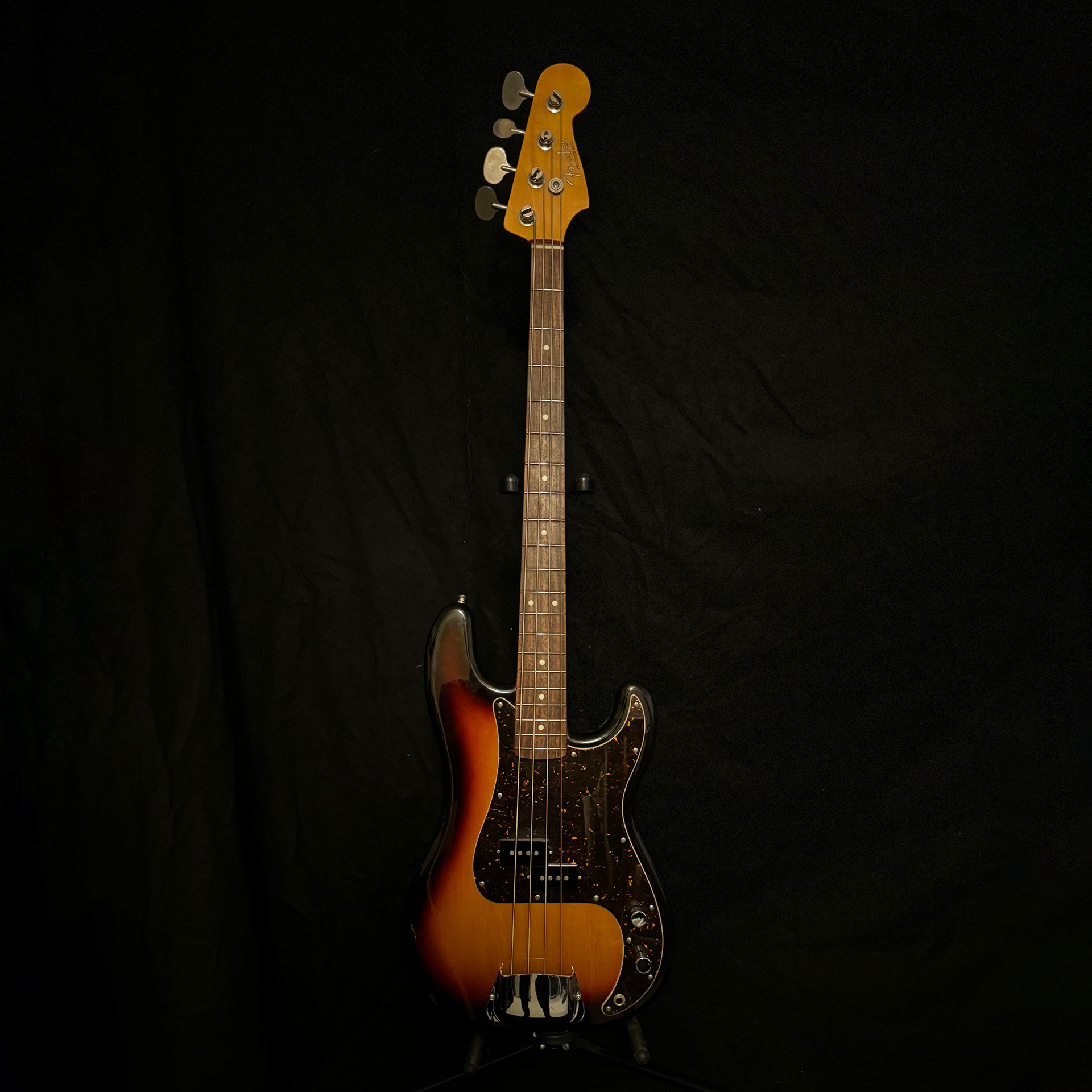
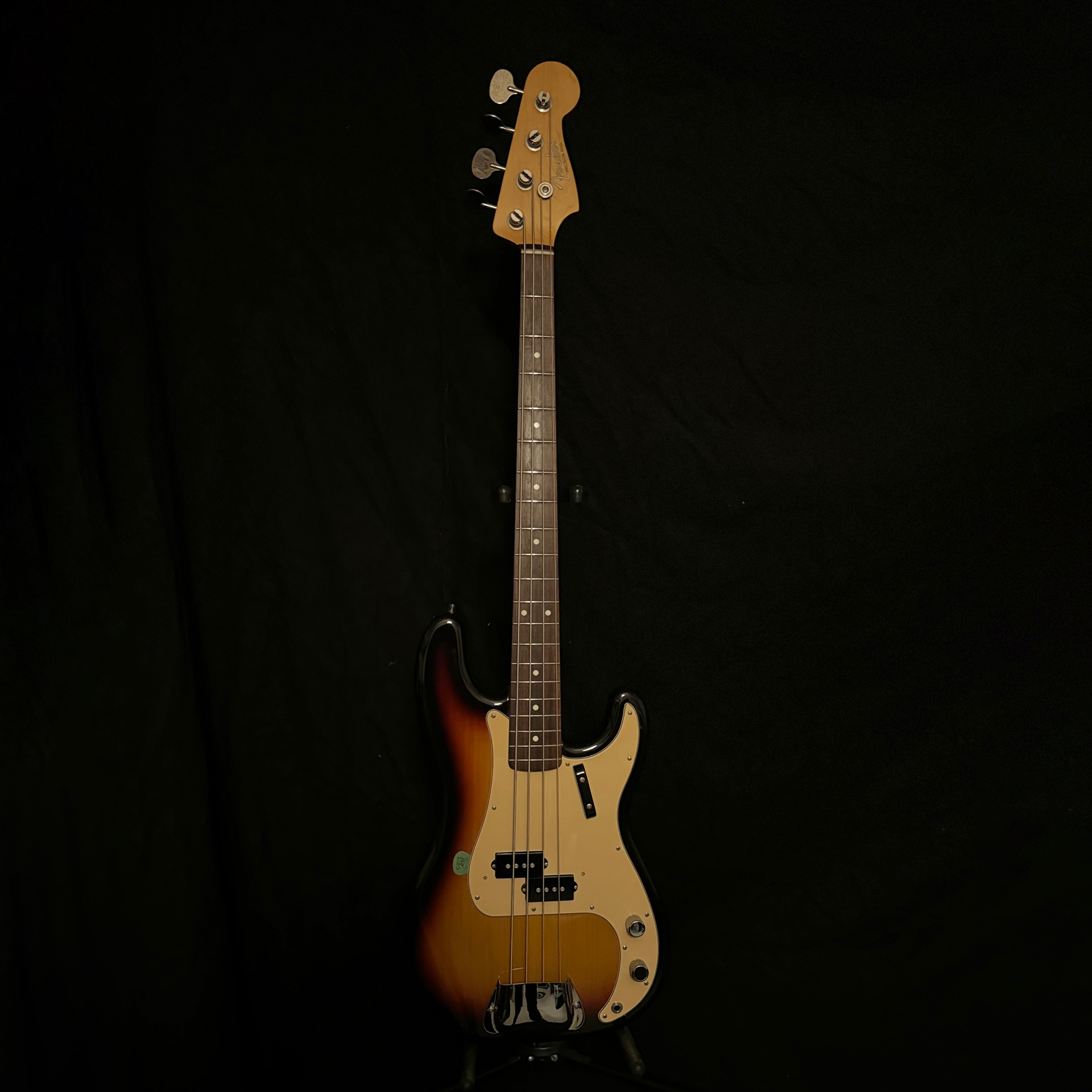

Hama Okamoto #4 specifications
| Spec | Detail |
|---|---|
| Body wood | Basswood |
| Body finish | Gloss Polyester |
| Neck wood | Maple |
| Neck profile | Classic ’60s Jazz Bass® |
| Fingerboard | Rosewood |
| Fingerboard radius | 7.25″ vintage |
| Frets | 20 |
| Scale length | 34″ long scale |
| Pickup | Vintage-Style Split Single-Coil Precision Bass® |
| Controls | Master Volume, Master Tone |
| Bridge | 4-Saddle Vintage-Style with Bridge Cover |
| Tuners | Vintage-Style “Lollipop” |
| Typical weight | ~3,8 – 3,9 kg |
| Country of origin | Made in Japan |
What the “#4” actually means
Fender has coded neck widths by letter since the 1960s. The letter was stamped on the neck heel, and it told you one thing: the width at the nut.
| Code | Nut width | Where you normally find it |
|---|---|---|
| A | 1.5″ / 38 mm | Jazz Bass |
| B | 1.625″ / 41,3 mm | Precision Bass |
| C | 1.75″ / 44,5 mm | Wide-neck options |
| D | 1.875″ / 47,6 mm | Widest, rare on basses |
A standard Precision is a B. A Jazz is an A. The gap between them is 3,3 mm, which sounds like nothing written down and feels like a different instrument under your hand – it is the single most common reason a player picks a Jazz over a Precision, and it has nothing to do with tone.
Okamoto’s own 1968 Precision carries the narrow nut. Fender still built Precisions that way in the late ’60s, so the bass he plays is not a modification or a parts instrument – it is a factory spec that stopped being common. The #4 brings it back: A-width nut, U-shaped profile, Precision body, Precision pickup.
So when a listing says “Hama Okamoto Precision Bass #4”, the number is not telling you which one it is. It is telling you what the neck does.
Fender Japan Hama Okamoto #4 FAQ
What does the “#4” mean on a Hama Okamoto Precision Bass?
It names a neck profile, not a position in a series. Fender designated the custom shape built for Hama Okamoto as the #4: a 38 mm nut in a U profile, fitted to a standard Precision Bass body and pickup. There is no #1 through #3 – the number is a spec designation, written in Japan as the “Number 4 shape”.
Why does a Precision Bass have a Jazz Bass neck?
Because Okamoto plays a 1968 Precision that has one. Fender’s historical neck-width codes ran A through D, with A at 1.5″ / 38 mm and the standard Precision B at 1.625″ / 41,3 mm. Narrow-nut Precisions were a factory option in the late ’60s and largely disappeared afterwards. The #4 reproduces that spec, so you get the Precision’s split-coil punch with a neck that measures the same as a Jazz at the nut.
How wide is the nut on a Hama Okamoto #4?
38,1 mm. I have measured all three in the vault – 2016, 2017 and 2018 – and they read 38,1 mm, which is measurement tolerance rather than a spec change. The profile held steady across the production runs.
Who is Hama Okamoto?
The bassist of OKAMOTO’S, one of the better-known Japanese rock bands of the last fifteen years, and a player with enough standing at Fender Japan to get a signature instrument built to his own neck spec rather than a finish change on an existing model. Fender also released a Hama Okamoto signature Katana in 2021.
Is the Hama Okamoto #4 available outside Japan?
Not easily, but it is not a discontinued rarity either. Fender Japan still lists the #4 on its own site, and it has come back into stock there. What it does not have is an export route – it is a domestic model, so it does not appear in Fender’s European or American catalogues and your local dealer cannot order one.
Which leaves the used market in Japan, and that is where all three of mine came from: bought secondhand, each from a different private seller. Expect to work through a proxy service, expect the shipping and import duty to be a real line in the budget rather than a rounding error, and expect the listing photographs to be better than the descriptions.
Did the Hama Okamoto #4 change between 2016 and 2018?
The instrument did not. The range did.
Across three consecutive years the specification holds: I measure the nut at 38 to 38,1 mm on the 2016, the 2017 and the 2018, which is measurement tolerance rather than a revision. Nothing in the profile moved.
What changed is the palette. Olympic White joined the line in 2018; the earlier runs were 3-Color Sunburst only. That makes the finish a dating shortcut – a white #4 cannot be an early one, and if a listing pairs Olympic White with a 2016 or 2017 date, one of those two facts could be wrong.
Is the Hama Okamoto #4 worth buying?
If you want a Precision and have always found the neck too wide, it is close to the only factory answer to that problem – and the alternative is hunting a ’60s narrow-nut original at many times the price. If the Precision neck has never bothered you, the #4 offers nothing a standard P-Bass does not, and you would be paying a Japanese-domestic-market premium for a neck you did not need.
Henrik Bonde Hanfgarn owns three Hama Okamoto Precision Bass #4s, spanning 2016 to 2018 in both finishes. The measurements and specs here are taken off those three instruments. About Henrik.
Where to go from here
- Date your own Field Guide to Fender Japan: MIJ & CIJ eras
- The reissue Precision Fender PB-70 ’70 Reissue
- Other signature instruments Artist signature basses in the vault